Wednesday 10 March 2026
Barony Plate
Tuesday’s session of the Falkirk Writers’ Circle sawthe adjudication for the Barony Plate, the competition asking writers to submit a short sketch. Katie White, a BAFTA nominated scriptwriter was the adjudicator and the winning entry was ‘Keeping George Occupied’ written by John Spowart. Malcolm Macdonald’s ‘Pyoor-ree’ was second with a special mention for ‘I Spy’ by Ann Maree Campbell.

Wednesday 25 February 2026
Forth Environment Link‘s Writing Competition
Tuesday was the adjudication night for the Forth Environment Link‘s writing competition, entrants having had to complete a piece either fiction or non fiction, on what climate change means to them and how it affects them. The winning entry came from one of the newer members to the Circle the piece titled ‘Surge’. Stephen Aitkenhead, the spokesman for the group, presented the trophy and read out the results and as well as providing a plaque for the winner Each entrant was also presented with a glossy certificate and a lovely thank you gift of a sustainable notebook and pencil, all in an attractive folder with a copy of their entry.
The Forth Environment Link photographer Julie took pictures for them to use in other settings. The entries are to be used all year in various settings as the group publicise Climate Action in the Forth Valley.
Forth Environment Link also provided a beautifully catered Indian buffet catering to all tastes from Vegan to Meat Eaters and all in between with even some gluten free stuff. It was all delicious and the sweet treats including stuffed dates dipped in chocolate were amazing. Steffie was very happy to encourage us all to eat far too much but it was very tasty!!!
There was also a story from Jen from the Sensory Project in Falkirk who also works with FEL highlighting ways parks could improve facilities for disabled users such as those with sensory deprivation such as deafness or degrees of blindness. She may consider joining the Writer’s Circle in the future now she has discovered she can write. Her story was very good and thought provoking.
A selection of comments from the judges regarding some of the entries from Falkirk Writer’s Circle were as follows:
The Obituary-loved the unique format of the obituary to consider the loss of Artic ice to a person.
Past, Present Future– transported one back to a different time when simplicity lent to contentment with what we had. Made the reader think of the impact of climate change across generations.
Polmont’s Thunderstorm (and the flash floods of 11th and 12th August 2020) -enjoyed the third person perspective and very educational on some local experiences from the impacts of climate change.
Hamish’s Hypothesis – a bit serious but a bit tongue in cheek at the same time. The introduction and ending text around the poem made it quite ‘meta’ like it was breaking the fourth wall. Liked how it mentioned huge volumes of CO2 had been present in the ancient past so climate change has happened before but pointed out when it reoccurs we won’t survive it.
A Beautiful Day in the Morning – a grim story intended to sway the reader to be anti sea-eagle perhaps, sets scene well, conflicting messages highlight how complex conflict is between agriculture and environmental policy.
Impact of climate change on writers in Scotland – liked the interview style of the piece, exchange highlights that the younger generation live with climate-anxiety or more accurately climate grief because it IS happening. Reflective thoughts from the interviewer are insightful as empathy is important across generations.
Winning entry was “Surge” – paints a picture of a possible future of what life across the Fourth Valley could look like with rising water levels. Very poignant story telling involving a vista from Blackness.
Everyone was very appreciative of the efforts FEL had made to make the experience a positive one for all concerned.
Wednesday 26 November 2025
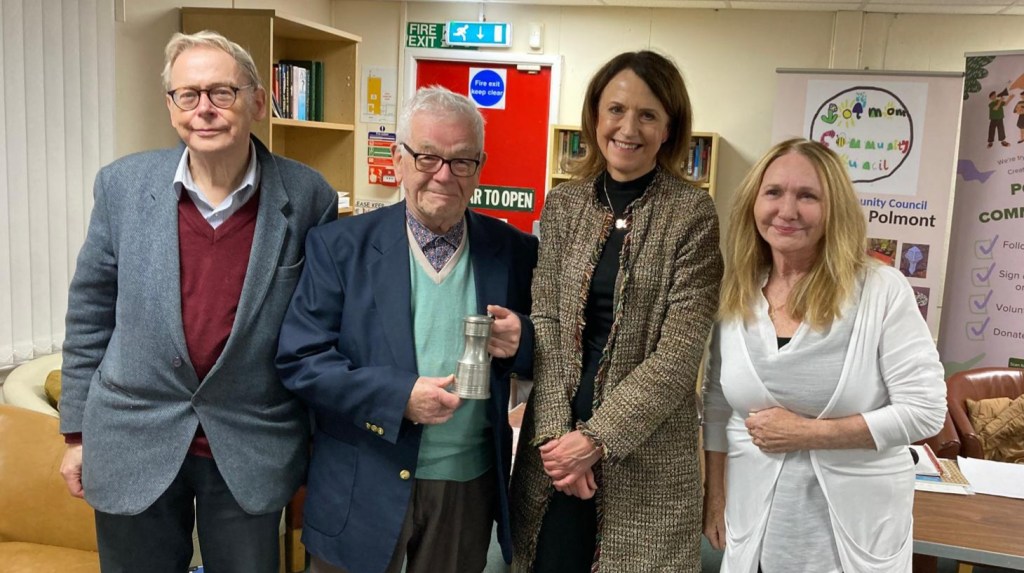
Falkirk Writers’ Chair Ann Maree Campbell presents the Makar Quaich to the winner of this year’s short story competition Kennedy Smith for his tale ‘Jamie’s Coo’ (Story posted below)
JAIMIE’S COO
He sat on a dry tussock of grass and gazed at the distant Galloway Hills, his hills. His collie, Nell, too sat there and nuzzled into the shelter of the aged shepherd; the snell wind had a cold bite, although the dog was more interested in the whaup hovering overhead.
The locals called him, “Auld Jaimie” or “The ‘Herd”. He was part of the Rhinns and they would nod to him any time he entered the Kennedy Arms. He accepted their greeting and their glass of ale, before wandering over to his usual nook near the fire. Perhaps he was storing its heat before again facing the rigours of autumn.
But Jaimie was not always ‘Old’ nor was his hair always white. It was Jaim the Lad and his hair was violently red – and the lassies kent fine he was a lad. They knew too that he was never short of a bob or twa though where it came from, no-one knew; sure, he worked herding occasionally yet that was hardly a paying job and he wasn’t saying. No! the truth was that Jaim was into some sort of smuggling racket, or so they said with a wheesht forefinger. Aucht, there were times when he was outside the law but that is just being pernickety.
However, there was that occasion when he was helping with the herding of kye from Kirkcudbright to Carsphairn on the edge of the Rhines o’ Kells. At the Solway end, there were twenty three beasts corralled in a makeshift pen with the usual assortment of drovers preparing the way. Jaim was there too helping -in his way. In actual fact, he was moving among the stock reviewing their potential.
With the evening creeping in, all was ready and the herd set off at a steady plod. Needless to say, the cattle too set off at their own private pace with an occasional bellow and a plop, plop, plop of muck, as is their want. It all seemed so slow for the likes of Jaim but the gaffer didn’t want the beasts to shed their weight before Market.
The group covered about a mile in the first hour before the evening darkness reached them and the chill of the autumn air descended. There was no moon to guide them, yet in the gloom the starlight was enough to show the well-trodden way. After all, this was the main route between the two villages.
A few miles along this road was a stream running off the Rhinns; Jaim was listening for this. It was to be a marker for him and his loot to leave their companions. He only hoped to pick the right stream, for the night was full of the sound of running water. It was that sort of country. ‘It must be that one’, he thought and as the night crept on, Jaim with a coo slipped into the dark. It was the simplest of moves with ne’er a sound from either, not even a farewell.
Jaim and his companion coo paused just off the roadside to let the stragglers clear before taking a new route towards the source of the stream. The way was rough through unseen turf and soft ground with the going improving as they rose to the drier, rocky terrain. The stream was no longer; just rock. Indeed, the going became so hazardous, either could have fallen at the numerous scarps.
The slope, the starlight and luck led them to the saddle, then onto the down slope, the west face of the Rhinns. To Jaim it seemed the coo knew the route better than he did and grabbing its tail, he decided to follow the beastie.
It led the way into the blackness of a chasm, or so it seemed. The ground under his feet felt loose and before he realised, he was sliding unchecked down a scree to an abrupt end and a chorus of curses. He could just imagine his companion looking towards the heavens in exasperation.
After regaining his breath, Jaim carefully extracted himself from the scree. There was the coo, or rather its outline, waiting impatiently. Jaim angrily grabbed its tail again and they continued their descent, but more carefully. The coo expressed her feelings with another plop, plop, plop, this time with a gust of wind.
The air grew colder; the stars disappeared and cloud formed to settled on the land as mist. With no Pole Star to guide him and no land marks, Jaim was lost in this desolate world. It was taking on a grey whiteness with the breaking of the day. Still, the two loan figures pressed on, the cow leading the way.
They had reach the flat where the two main rivers, the Gala Lane and the Eglin Lane should rise; but there was no a sign of either. The two lone figures pressed on, with Jaim suspecting they were plodding in wetter and wetter circles. Suddenly the mist simply vanished and all the familiar landmarks materialized. The points of the compass were reckoned and all fell into place.
Dead ahead, Jaim could see a familiar shepherd’s bothy, the Backhill o’ the Bush and they were making straight for it. It would be a convenient break and he had some scraps for rations. The tethered cow would make do with that patch of lush grass.
Arriving at the bothy, Jaim chapped at the door and entered the empty homestead. Judging by the clutter and neglect, it seemed as though it had been abandoned for some time. He would rest, have his frugal meal washed down with some warm milk fresh from its source. It gave Jaim time to check out his position and plan his next move. Somehow he had to hide the thieved animal till the heat
died down; where better then but in a crowded field with other beasts. Auntie Jessie’s homestead was just west of here in Glen Trool. He would visit her.
By the middle of the day, a rested Jaim and cow started off on the next stage of the trek. This time, he was leading.
He failed to improve the pace in spite off his frequent tugs on the halter; he just had to be content with something like one mile every hour. The ground was sodden; it was always sodden over this great plain moorland of rough tough grass-and-peat plane.
So it continued, one sopping wet boot after another; one quaggy hoof followed by three others. Time slipped away and was replaced by dreich boredom and fading light. To some extent they both were on auto-pilot except that it had not then been invented.
Suddenly, the cow stopped dead in its tracks. It refused to budge no matter Jaimie’s tugs and wrenches, yanks and heaves. It just refused to move.
Jaim turned and stared at the stubborn beast; and stared and stared and stared. It was then that he realised that he was slowly and silently sinking into the bog. They had wandered into the Silver Flow, that infamous bog that had swallowed many an unthinking traveller; for this was their route to Loch Enoch.
Their prize there was the white grit of its shores treasured for sharpening various tools – and of course knives. The coo had sensed the danger.
Jaim tugged and pulled at the cow’s tether, pulled free one foot and then the other, followed by the first as it was enticed back into the mire. In the end, he lay on his back and let the coo drag him free. That was when he disgorged his bread and milk lunch.
* * *
Much has changed since that evening; almost fifty years since the day the two muddy figures stumbled into Aunty Jessie’s backyard. She took one look at Jaim, broke the ice on the water butt and filled the tub. She plunged the protesting filthy figure into the ice bath and left him there to soak and freeze. The cow she led to the field to look after herself with little to graze. Years later, Jaim inherited Jessie’s steading and settled down. His hair turned grey and then white with the years.
Jaim took good care of Belle – he called the coo Belle following their adventures; taking her to good sweet pastures in the long days and giving her bailed hay in the winter byre. He never did sell Belle but kept her as a milking cow all her days.
Here he was braving the same cold winds, stretching his eyes to the distant Rhinns. Only that morning he had watched the sun rise up over their purple tops reminding him of a passage from a MacCaig poem:[1]
. . . And a spell is broken; suddenly Time scratches
The hour on its box and up flares a new day.
[1] End of a cold night – Norman MacCaig, Collected Poems, Chatto & Windus, 1990
FALKIRK WRITERS’ CIRCLE
CLUB COMPETITION
TUESDAY 3rd MARCH 2026
“BARONY PLATE”
5 MINUTE SKETCH FOR 2/3 CHARACTERS
ADJUDICATOR – KATIE WHIT
There is no entry fee
Entrants will be expected to attend on the evening
Entries should be in the following format:
A front page with TITLE…PSEUDONYM…NUMBER OF WORDS/LINES
An envelope should be attached showing TITLE AND PSEUDONYM
on the outside and entrants NAME inside
All entries should be typed in DOUBLE spacing on one side of A4 paper
ENTRIES SHOULD NOT HAVE PREVIOUSLY BEEN PUBLISHED (this includes Circle Anthologies), seen by the adjudicator or have been placed 1st, 2nd, or 3rd in previous competitions.
ONE ENTRY PER PERSON
CLOSING DATE FOR ENTRIES
TUESDAY 13th January 2026
To
Isobel Quinn, 73C Alma Street, Falkirk, FK2 7HE
FALKIRK WRITERS’ CIRCLE
CLUB COMPETITION
TUESDAY 31st MARCH 2026
“ALLAN BROWNLIE QUAICH”
POEM – ANYT SUBJECT – MAXIMUM 40 LINES
ADJUDICATOR – KATH HARDIE
There is no entry fee
Entrants will be expected to attend on the evening
Entries should be in the following format:
A front page with TITLE…PSEUDONYM…NUMBER OF WORDS/LINES
An envelope should be attached showing TITLE AND PSEUDONYM
on the outside and entrants NAME inside
All entries should be typed in DOUBLE spacing on one side of A4 paper
ENTRIES SHOULD NOT HAVE PREVIOUSLY BEEN PUBLISHED (this includes Circle Anthologies), seen by the adjudicator or have been placed 1st, 2nd, or 3rd in previous competitions.
ONE ENTRY PER PERSON
CLOSING DATE FOR ENTRIES
TUESDAY 3rd February 2026
To
Isobel Quinn, 73C Alma Street, Falkirk, FK2 7HE
Helen Cunningham Plate
This week’s Falkirk Writers’ Circle featured the adjudication of the short story competition for the Helen Cunningham Plate, Local historian and writer Ian Scott had the task of selecting the winning entries with the prize winners as follows. The trophy was presented to Archie Smith for his story ‘His Kingdom’ a tale about an old man’s life in a small fishing village. The second place story was ‘The Way to Escape’ by Alec Chalmers and Douglas Ramsay was third with ‘An Awful Event on Deep Southern Rail’. Here is Archie’s story:
HIS KINGDOM
SEA-DOG
The old man looked around at the familiar surroundings, a row of lime-washed cottages staring out at the ever-restless sea beyond the through road. Over there was an agéd jetty almost as old as himself. He well remembered helping to build it with tar washed timbers from some convenient wreck on Scars Rock. He was young then; he sighed and spat into the dust at his sea boots. His row-boat, with oars tucked under the seat, was tied to the jetty. It too spat into the occasional rogue wave.
The old man spent many winter hours caring for his craft. It was under cover in Dougie’s shed to keep out the worst of the storms, although knowing Dougie, the shed itself could be doing with some care. Many an hour was spent scraping and sanding the boat’s timbers down to the wood before applying the first thin coat of varnish. Further coats would follow and there ensuing, would be a rejuvenated vessel, his pride and joy. The boat had no name and was always just known as The Old Man’s Boat; for he seemed to have no name either.
On a mooring post, a lone gull perched. It too looked out to sea but with an evil eye as though planning the next mugging for victuals. On its cruel beak there seemed to be a smear of scarlet lipstick gone wrong. On a whim it took off with an oath and a raucous rallying call to some distant rogue cousin.
The old man stirred himself from his dwam and set a course between red and green for The Creel o’ Herring, the watering hole at the end of the village. It too belonged to Dougie. As he entered, the man himself greeted him. “You’ll be having a drink then, Jimmy!” He called everyone ‘Jimmy’, hailing as he did from Glasgow.
The old man sat in his favourite corner with his glass for company. He rarely spoke, just sat there quaffing the ale, drinking in the banter. The air was full of sea-faring chatter, the talk of fish, of boats, of shoals and rocks – the time Hamish fell overboard and drank in half the Atlantic Ocean and then drank all Dougie’s ale trying to rid the taste of salt. The air was full of smoke and tarry rope. That was his kind of place.
The crowd rarely spoke to the old man. They would look into his eyes and see the signs: private, no trespassers. He was part of the furniture and was accepted as such. He simply sat there in his corner, a hint of a smile and the occasional nod to an acquaintance; not to a friend, for he had few of those still in the land of the living. Now and then, someone would whisper with others; they would talk about him, how old was he, his history, where he fished; for they guessed he was a fisherman. Yet in the main, he was just part of the furniture, old and gnarled and stained dark with time. And they would spit on the sawdust floor and talk of other things.
The old man up and left The Creel before the liquor-fuelled arguments started. It was dusk and the brighter stars had appeared as he boarded his craft and rowed into a gentle sea. He enjoyed this share of the day. He could lean on his oars and savour this tail end; the shy movement on the swell; the taste of salt and the hint of tar rope; the chuckle of wavelets on the stem. Here he could contemplate the meaning of life, of his life in particular and let the memories slip by. This was his domain, a realm of peace where he could let his mind wander through other worlds and think of the experiences there. This was his Kingdom.
After a bit he dropped a line and pulled in a couple of mackerel and, as luck would have it, a whiting. “Mistress Thomson will enjoy that and I’ll have the others for my supper,” he thought. And the spell of the evening was broken as he returned to the staithe.
Later that year – the early autumn it was, and the wind was coming from the east – the old man took in the tether and pushed the boat away from the key as the dipping oar turned the prow into the chop; for with wind against tide, little combers had built up. It was one of those autumn evenings when the sky turned luminous and evenly bright, almost dazzling yet without any discernable cloud.
The boat drifted with the breeze and needed little guidance only the occasional dip of a blade to keep it on course. The tidy craft jigged over the swell to the excitement of 6/8 time, enough to send a foot tapping; and the old man was content. With his back to the tide and the village in the distance, he was pleased and leaned on the oars with a sigh. After a time, the featureless sky softened and dropped to kiss the water and the old man sailed into his Elysium Sea between the green starboard light and red.
Three days later, they found his boat some miles beyond the village bay. The remains of the old man were still slumped over the oars as they towed the craft back to the village. There they beached the boat and they buried the body in the kirkyard with due ceremony from the priest in mourning purple.
With a stone at his head, the old man faced the sea and his upturned boat on the shore. Scratched on the stone was simply, “Unknown Seaman.” Soon, the stone and its legend merged with the moss and only the ribs of the boat jutted from the sand. Yet some say that they see him still in his corner in the Creel o’ Herring with his glass of ale.
. . . . He’d go into the cold air
And the wider silence and smile in it to see
The friendly water and himself waiting there.[1]
[1] Norman MacCaig
FALKIRK WRITERS’ CIRCLE TRYST SEMINAR
Saturday 17 May 2025 Polmont Community Hub, Greenpark Drive Polmont
Programme
Morning Session
9.45 Coffee
10.15 Welcome
10.30 Adjudication of Short Story competition
Ann MacLaren
11.00 Reading of winning Short Story and prize giving
11.30 Adjudication of the Article competition
David McVey
12.00 Reading of the winning Article and prize giving
12.30 Lunch
Afternoon Session
2.00 Adjudication of Poetry competition
Laura Fyfe
2.30 Reading of the winning Poem and prize giving
3.00 Adjudication of Special Category (Dorothy Whamond Trophy)
Wildlife theme
Kate Blackadder
3.30 Reading of the winning Special Category and prize giving
4.00 Closing remarks
………………………………………………………………………………………………………………………
COMPETITION DETAILS
Short Story any subject Maximum length 1500 words
Article any subject Maximum length 1200 words
Poetry any subject Maximum length 40 lines
Special Category: (Dorothy Whamond Trophy) Wildlife Theme Maximum length 1500 words
Three prizes in each category: 1st £15; 2nd £10; 3rd £5
FALKIRK WRITERS’ CIRCLE TRYST SEMINAR 2025
Competition Rules
Entries can be accepted only from those attending the Seminar.
Don’t send any manuscripts previously published, seen by the adjudicator, or under current submission to another competition or market.
Typewritten entries only please, double spaced, on one side of A4 paper.
State the number of words and pseudonym on cover sheet.
Don’t show your name on any manuscript.
Write your name and Club name on a piece of paper and seal it inside a small envelope. On the front of the envelope write: Your pseudonym Title of entry Category of competition
Attach the envelope to your entry with a paper clip Attach one of these envelopes to each entry
Fees for competitions are £2 for each entry, maximum of one entry in each category.
Cheques to be made payable to Falkirk Writers’ Circle or direct to bank account Falkirk Writers’ Circle: Sort Code 80 15 95 Account No 00315047 (Receipts will be issued only by special request and if SAE is sent)
Send all entries with registration slip and payment (seminar fee + fees) to Morven Mack, 136 Muirhall Road, Larbert FK5 4RE
DEADLINE FOR RECEIPT OF ENTRIES IS 2nd April 2025 Fees are non-returnable £35.00 Competitions £2 per entry (maximum 4 entries)
…………………………………………………………………………………………………………………
REGISTRATION SLIP Return by 2nd April 2025 NB: One required for each person
NAME: CLUB
ADDRESS: * Competition fees £2 (each)Telephone No: email address:
Total amount tendered : £ _____________
Silvie Taylor Quaich
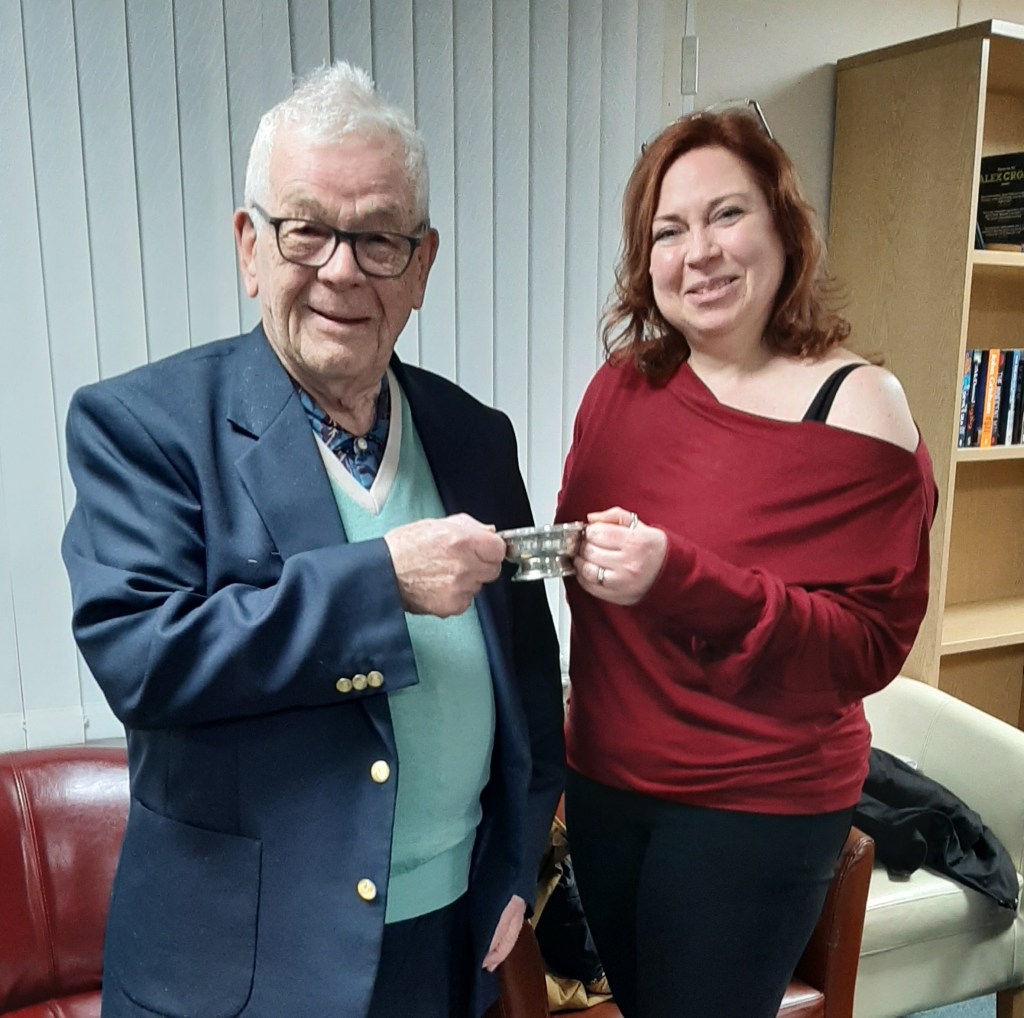
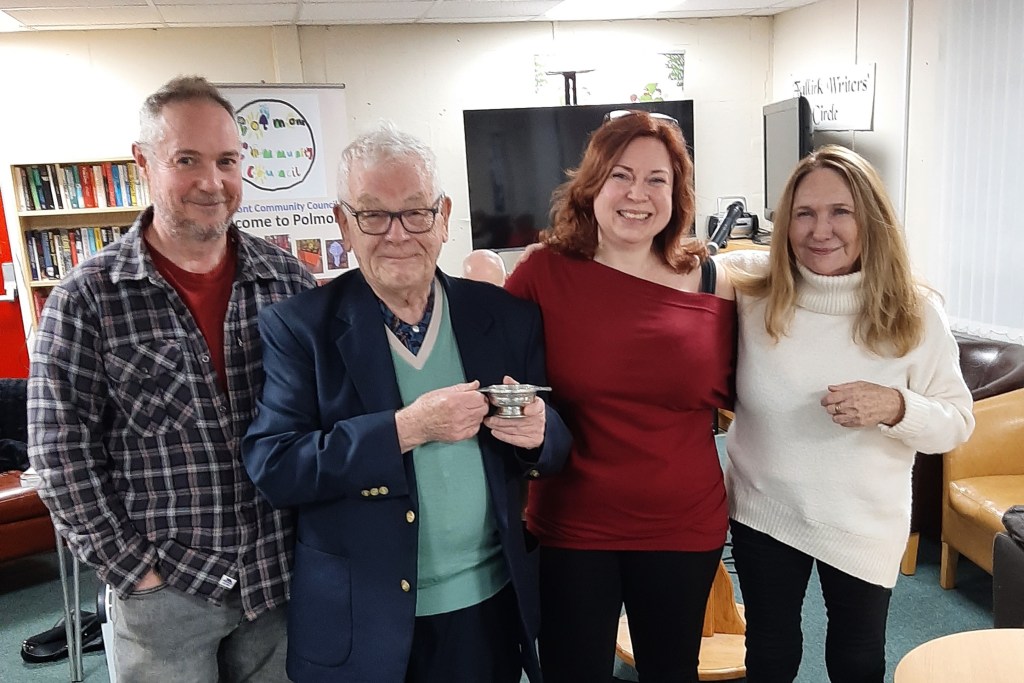
Falkirk Writers’ Circle good friend, Laura Fyfe was the adjudicator of the poetry competition for the Silvie Taylor Quaich. The winning poem was ‘The Coppiced Forest’ by Archie Smith. Second place went to Dougie Shepherd with his poem ‘Samhain’ and ‘Our Planet’ by Margaret Smith was declared third. Wendy Dick and John Spowart were highly commended and commended respectively for their poems ‘Emergence’ and ‘Ode to Ma Bike’.
THE COPPICED FOREST
by Baldy Bain (Kennedy Smith)
When in ma youth wi’ naught tae dae,
A’d daunder doun by Taynuilt Brae
And ponder there awee tae pray,
Ma brain’s aw jelly;
For there beyond the dyke there lay
The Wids o’ Nellie.
An whiles as Aa sat in a dwam,
Aa wis aware o’ scented balm;
While sounds o’ singing split the calm –
A lassie singin’?
A melody with ghostly charm
Yet sweetly ringing.
The weel kent air frae forest slid –
A mirksome pairt wi coppiced wid.
A widnae tak a tanner bid
Tae gang tharein.
Yet a wis poued tae dark unlit
An blackness grim.
Dark doon through a’ the coppiced wood,
Where trees like umbrellas stood.
Black the trees an’ black the mood
In Wids o’ Nellie;
Nor nae a sound tae brak this mood
Save rumbling belly.
Now all at once, in glade fu bright,
Aa spied in coppice cage held tight,
A skeleton wi bones sae white
Aw’ hingin’ there.
Idly swaying, left tae right
And red o’ hair.
A gentle wind blew cross the bones
And raised the soond o’ semitones,
Tae cry to me like bagpipe drones –
Yon skirls fae Hell;
While roon her neck a pendent moans:
“Bonnie Nell”.
Tappit Heid
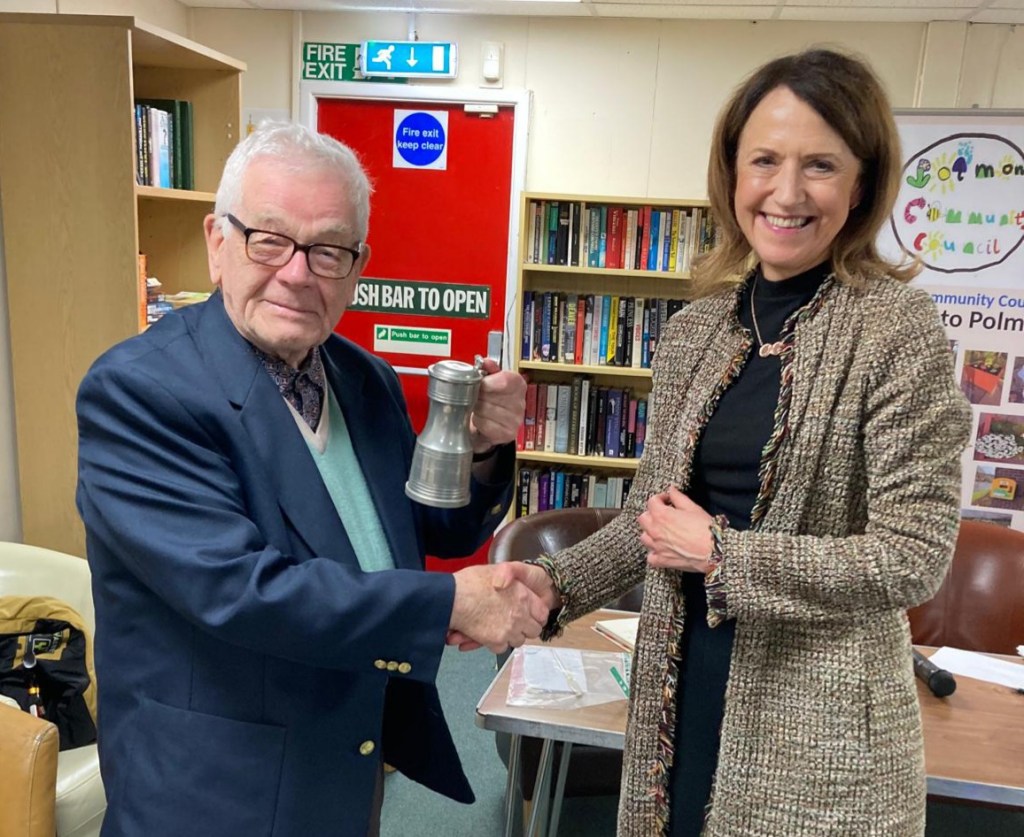
Tuesday night saw the adjudication of the Article Competition for the Tappit Heid, the entries judged by Falkirk Herald Editor, Jill Buchanan The Tappit Heid was awarded to Archie Smith for his article “Toothy Peg” a humorous piece about teeth. Second Place article was “The Dam Builders written by Douglas Ramsay. Third Place article was “A Watery Grave For A Scottish Witch written by Margaret Smith
Here is Archie’s article:
TOOTHY PEGS
GUMSY
That was what my mother called my teeth when I was a kid. “Go and brush your toothy pegs!” she’d say when I had forgotten – frequently. It has stuck ever since.
For some reason, dentures were a source of japes, the cynosure of various music hall jokes; they were usually referred to as wallies. There were wallies in tumblers of water leering from bedside tables – They would be spat from her wide-open mouth as the soprano hit her top note – Grandpa was sitting on his long-lost wallies.
I am blessed with a Terry Thomas gap between my two front teeth. Imagine my delight then when I discovered that Chaucer’s Wife of Bath too had gaps in her teeth, Gat-tothed was she, soothly for to seye. Chaucer makes no mention of Terry Thomas.
When I sit down to watch TV, I have certain difficulties. In many dramas, I seem to get confused between the various characters not just because they all seem to have the same name. They all look alike too. All the men have beards and gleaming white teeth. The ladies, mostly, have no beards and also gleaming white teeth. Has TV been taken over by clones or constructed using AI?
The other evening I was watching ‘Strictly Come Dancing’ (or ‘Strictly’, if they were economising on words.) With the opening credits, each couple, or clone, danced, flashing their brilliantly white teeth at the camera. Were they different couples? Or was it just one quick-change artist?
In their dance routine, I examined each individual duo. I tried to get inside their heads. What was each couple thinking? I arrived at a variety of answers.
I am no dancer, yet I am able to identify individual dances. The first pair demonstrated their version of the Viennese Waltz, that much I did know; it was The Blue Danube. The fixed smiles (and teeth) gave nothing away. However, as they whirled round, their averted heads suggested that there was a bad breath problem.
Throughout The Tango, with long strides, abrupt stops and arrogant twists, I could detect toothy smiles of a leering duo giving a brief white-out of the screen. Luckily, the nature of the dance meant that only one set of gleaming whites was exposed at a time.
A Quickstep clone stepped quickly into the picture with a most complicated collection of shuffles and stamps in rapid succession while gazing at the partners’ teeth. There was a hint of pain there as toes were subjected to agonies.
A blaze of orange burst onto the screen, twisting and writhing, this way and that, still flashing ultra-white teeth. Apparently, this was the Jitterbug not unlike two flies trapped in my jar of marmalade. The flies didn’t smile.
The flamenco dancers next rattled the screen with their stomping of heels and the clatter of castanets, white castanets would you believe. For a moment I thought they had removed their teeth to jar the senses, but no! their gleaming wallies were still there, six menacing inches apart.
Fearful of over exposure and damage to my set (my TV set) I leaned over; “Where is the off-switch?”
All these clones set me thinking of the personalities of the screen of yesteryear; they seemed unconcerned about their teeth. Rather, they were part of their personality. Terry Thomas used his gap to convey a roguish fellow. Ken Dodd had those mad-look teeth. Jimmy Tarbuck’s were part of his quick-fire comedian personality. Edward G. Robinson seemed to have no teeth at all. The lady stars relied on their own teeth without any embellishment.
Then again, if an actor wished to add colour to a persona, a gap would be added; a country bumpkin would have his yokel gap; the town gangster would have his thug hiatus; the ‘dirty rat’ would have his felon’s yellowed set to go with his black fedora; should the character be really evil, he would have a stainless steel array. Actresses seem to resist all attempts to alter their teeth disposition.
Then of course there is the Hammer series of films promoting vampire teeth, long pointy things dripping with pretend blood. Now, there’s an idea for a ‘Strictly’ opening sequence.
Sometimes I wonder if teeth have been sent to torment us. Think of all that time taken to scrub the blasted things; and to what end? Yet another trip to the dentist for another expensive treatment. I know they have a purpose. They chomp up your food into little bits; they are useful for undoing knots in string; they are essential for gritting in temper-fraying situations.
That night with teeth on my mind, I went to bed to sleep, not to enter a nightmare-ish world. Perhaps it was the supper of cocoa and rum but if truth be told, I put it down to all those teeth on Tele. Out of the depths came a whole host of them, all gleaming white. Across my mind they danced forming all sorts of patterns, a trivet of teeth fashioned into prison bars before dissolving into choruses of choirs, all to the music of Saint-Säens’ Fossils. This entertainment, if you can call it that, continued on into the wee sma’ hours when I sank into nothingness.
When you think about it, teeth are so versatile. As mentioned, you can grit them to avoid friend-destroying words escaping even though they have been set on edge. The alternative of biting ones tongue is too painful to contemplate and as I’m new to this game and just cutting my teeth, I’ll just go and sook some sweeties (I have a sweet tooth, you know!) and to get me to elaborate would be like pulling teeth; so there!
I’m too long in the tooth to continue. So don’t bother me. I should warn you that I’m armed to the teeth and am likely to fight tooth and nail.
What! Cat got your tongue! That should be: “Cat got your wallies!”
FALKIRK WRITERS’ SEMINAR
SATURDAY 18th May 2024
SHORT STORY ADJUDICATED BY MARY EDWARD
COMMENDED EVIE CORKHILL LARGS WRITERS
HIGHLY COMMENDED JACK MUIR LARGS WRITERS
3RD PLACE DOUGIE SHEPHERD FALKIRK WRITERS
2ND PLACE CATHERINE OGSTON PERTH WRITERS
1ST PLACE ELEANOR FORDYCE ANGUS WRITERS
ARTICLE ADJUDICATED BY IAN SCOTT
3RD PLACE ELEANOR FORDYCE ANGUS WRITERS
2ND PLACE SHEILA SKINNER
1ST PLACE ANN MACLAREN STARTHKELVIN WRITER
POETRY ADJUDICATED BY JIM C WILSON
HIGHLY COMMENDED MARY IRVINE HELENSBURGH WRITERS
3RD PLACE ALEX NORRIS LARGS WRITERS
2ND PLACE ELEANOR FORDYCE ANGUS WRITERS
1ST PLACE ANN MACLAREN STRATHKELVIN WRITERS
DOROTHY WHAMOND TROPHY 1ST CHAPTER OF A CRIME NOVEL ADJUDICATED BY WILLIAM MCINTYRE
3RD PLACE M T KIELTY WRITERS’ /UMBRELLA
FACTOR2ND PLACE ELEANOR FORDYCE ANGUS WRITERS
1ST PLACE ANN MACLAREN STRATHKELVIN WRITERS
Wednesday 29 May 2024
Here is our own Dougie Shepherd’s short story that gained third place in our seminar
PASSPORT CONTROL
Jeremy Gregory awoke abruptly from a deep slumber when the shrill alarm on his mobile phone signalled that it was five-thirty and time for him to get up. After showering he crept gingerly downstairs so as not to disturb the rest of the family in their modest semi-detached house on the outskirts of Haddington. Downstairs, he boiled the kettle and poured the scalding water onto the instant coffee granules into his favourite Star Wars mug. He enjoyed the warming aroma it released and sipped it gently while flicking through his folder of papers for today’s meeting.
It was a cold, damp Tuesday morning and to say that Jeremy was extremely stressed was an understatement. He was catching the eight-fifteen flight to Berlin’s Brandenberg Airport. The alert on his mobile phone notified him to the Uber outside. After quickly grabbing his briefcase and passport from the dining room table he gulped the remainder of his coffee, before rushing from the house and into the waiting taxi, bound for Edinburgh Airport.
Traffic was unusually bad for the early hour of the day. He was fidgety. This was an important meeting. He needed to clinch the deal. It was vital for his firm’s survival. The taxi driver was a talker. Just what Jeremy could do without. Within minutes the driver had covered the weather, potholes, the escalating problem of vaping in schools and the Israeli/Palestine conflict. Jeremy rolled his eyes and kept his responses to a bare minimum with only the occasional nod.
Today could be the making of his career and was the culmination of many months of hard work for Jeremy. He had worked man and boy for Scotia Engineering, having worked his way up from starting on the production line at sixteen years old to his current post of Commercial Executive.
For the past two years, Jeremey had spearheaded a project which, if successful, would culminate in the merger of Scotia Engineering with the successful German firm, RhineTech Innovations. The merger would lead to the domination of the lucrative western European market, secure job opportunities, attract investment and result in significant levels of profits for the new firm, Deutchse-Scotia Technologies. Good for business. And particularly good for the career of one Jeremy Gregory where he’d undoubtedly become a partner in the new company with the lucrative lifestyle that it would undoubtedly bring him and his family. Just one final pitch to the Deutchse-Scotia board in a few hours and he was confident that the contract would be in the bag and ready for signing.
Once safely through the busy Sheriffhall Roundabout and onto the Edinburgh City Bypass, the taxi finally picked up a steady speed and Jeremey was able to relax a little. He reached into his briefcase and read over his notes for what seemed like the umpteenth time in the last few days.
‘I don’t want to be rude, but I really need to concentrate on my papers,’ Jeremy said irritably to the driver, as he began to give his views from the front of the taxi on fracking, heat pumps and hybrid cars. He hoped that might bring the driver’s incessant babble to an end. Jeremy wondered to himself why taxi drivers didn’t just become politicians since they seemed to know the perfect solution to every problem the world faced.
As the taxi drew into the rank at the airport, Jeremy unclipped his seatbelt, reached into his wallet and settled the fare with the driver. ‘Hope your day is a success, pal,’ the driver shouted as Jeremy leapt from the vehicle and made a determined walk towards the terminal building.
Inside the building, Jeremey felt the hum of activity which filled the air, a mixture of excited, grumpy, and confused travellers accompanied by the whirr of luggage case wheels. The bustling atmosphere resonated with the sounds of intercom announcements, passenger voices and the constant shuffle of footsteps.
Jeremy turned and headed up the escalator which took him to the security checking area. There he scanned his boarding pass from his phone app. The monitor displayed a bright green tick and the glass doors slid open allowing him access into the area. He could see throngs of people moving towards the security lanes, each person clutching tightly their hand luggage and personal belongings. Jermey joined a lane which moved slowly as the queue meandered in a snakelike fashion through a seemingly giant maze of barriers and ropes towards the X-ray machines. Jeremy was getting apprehensive. His flight was in less than an hour, and the queue seemed to be moving at a glacial pace.
He eventually collected a scuffed plastic tray into which he carefully placed his briefcase before emptying the contents of his suit pockets, removing his watch, and placed these into the tray. He was directed to remove his belt and shoes which he slid off and placed into a separate tray before placing both trays onto the conveyor belt where they slowly made their way towards the scanner.
While his trays went to be scanned a security officer gestured towards Jeremy to walk through the metal detector. He held his breath momentarily, hoping not to trigger an alarm. He heard a sharp beep, and the officer signalled for him to move to the side. He received a brief pat down and was cleared and went to collect his trays, slipping his shoes and belt back on and gathered up the rest of his belongings.
The security area emptied out into the cavernous duty-free shopping zone. Jeremy moved quickly through duty-free towards the departures area where he glanced up at the large departures board, which highlighted that his eight-fifteen Ryanair flight to Berlin was on time and now beginning to board at Gate 14.
Jeremy made his way to the gate where a short queue for priority passengers was beginning to form. Within a few minutes Ryanair staff took their place at the gate to check passengers’ boarding passes and passports for verification before allowing them to board the aircraft.
On reaching the front of the queue, Jeremy successfully scanned his boarding card for the second time that morning and handed over his passport to the gate agent to check. The gate agent closely scrutinized the document before furrowing his brows in concern. With a shake of his head, he politely informed Jeremy that the passport he had presented did not match the name on his boarding pass and he would be unable to board.
‘There must be some mistake,’ responded Jeremy, ‘could you let me have a look?’ The agent returned Jeremy’s passport, which he opened only to see the face of his thirteen-year-old son staring back at him.
Jeremy’s face reddened and he shouted, louder than he had intended to, ‘Simon you complete and utter little bast . . .’ and he let the remainder of the expletive hang in the air. ‘That’s my son’s passport. The little brat must have swapped them.’ He could feel the eyes of the queue bearing down on him.
‘I understand your situation, sir,’ the gate agent responded. ‘But I am very sorry, sir. Without a valid passport I am unable to permit you to board this flight. I suggest that you return home, retrieve your own passport and I am sure that our customer service team will do their utmost to see if you can get onto our next flight to Berlin which departs at fifteen-hundred-hours today.’
‘But that’s no good to me. Today is really important. I need to be on that flight you jobsworth little sh . . .’ Jeremy shrieked angrily.
‘Sir there really is no need to take that tone with me. International Aviation Law prevents you from making this flight without a valid passport. Now, if you will step aside there’s quite a queue forming now. I can’t do anything more for you in this unfortunate circumstance.’
Jeremy meekly complied and started moving towards the back of the gate, reaching into his jacket for his mobile phone.
Twenty-eight miles away in Haddington, Simon Gregory was up, dressed for school and noisily slurping Coco Pops for his breakfast. He was idly flicking through his Snapchat feed when his mobile phone rang. The screen announcing that it was Dad Calling. Simon instinctively knew that could only mean one thing and swiped Decline on the screen to reject the call before blocking his dad’s number and taking it as his cue to depart. Leaving his bowl of Cocoa Pops on the kitchen table half-eaten, Simon hurriedly grabbed his blazer and school bag, shouting upstairs ‘bye, Mum,’ as he opened the front door, went outside, and slammed it nosily shut behind him.
Although he was early for school, Simon smirked smugly to himself as he hurried away from the house thinking, that’ll teach my grumpy old Dad for confiscating my Xbox off me again. He would worry about the massive trouble that he was in and face the music later.
Dougie Shepherd
Agnes Ford Memorial Trophy
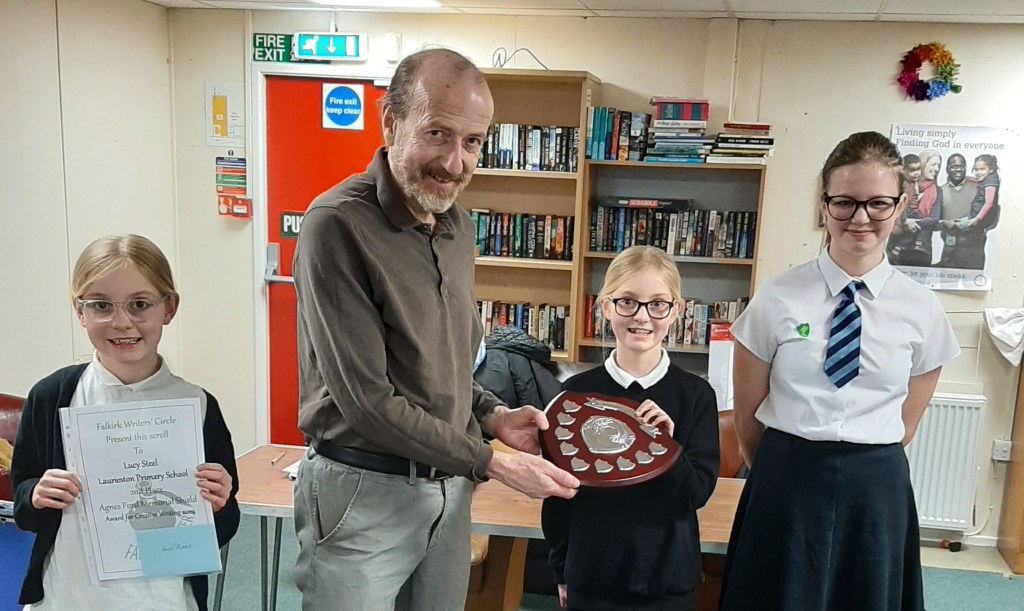
This week’s Falkirk Writers’ Circle saw pupils from Laurieston Primary School take centre stage with the presentation of the Agnes Ford Memorial Shield, the annual writing competition for one of the local schools. The winning entry was ‘Supernatural’ written by Holly Steel, her sister Lucy Steel in second place with ‘My New Room’. Amelie Irving scooped third with her story ‘The Last of Life’. Circle Chair Alec Chalmers made the presentation thanking the families for coming along with a special thanks to class teacher Mr Cooper for taking time out to be there.
Supernatural
Written by Holly Steel
I woke in the dark hotel hallway as the fallen lights flickered uncontrollably. I reached to feel my lips which seemed to have burst but as I reached further up my swollen face I felt it. I rushed to the mirror in the nearest room, the hotel was the only place in the town that wasn’t completely crushed or surrounded in warning tape. I looked frantically up at my face in the reflection then I saw it. A scar stretched across the sore ends of my forehead.
You might be wondering why the whole town is destroyed and I have a scar on my face so let me tell you a story of a scar…
It all started at 12:15 PM last weekend, on Saturday, when the miners working on the new underground tunnel claimed to have seen ‘odd shadows entering through a strange opening’. Quickly after that the tale happened to make its way to the news (surprisingly).
The next day nothing happened and no one really cared. Same with the next day. I think everyone forgot to be honest. Maybe they figured one of the miners had gone a bit mad. But then on Tuesday things got weird….
There had been more reports from the miners, then people heard little whispers in their sleep warning them of ‘disaster’ and quite frankly I was one of those people.
Things only went downhill from there…
Before long people started saying that they saw ghosts and evil fairies at night when they got the warnings from the whispers. Normally at night all building and house lights are turned off by ten PM but on Friday night the ground shook like a rocket was blasting of outside our big town. Hastily almost all of the towns’ people were outside their doorsteps checking out what catastrophic event was happening.
Before we knew it things were flying out of the ‘opening’; witches, warlocks, ghosts and monsters!
Quickly after they saw them the police were very busy wrapping warning tape all around the town’s structures to warn any cars that might enter. That’s all I can remember, after that my memory went blank. All I know is everyone was gone and so was any other form of life in the town.
Actually there is one thing I remember, I was thrown into the wet concrete when I was captured and taken into the hotel where I was slashed by a broom.
Wait I hear something coming.
“Ahhhhhhhhhhh!”
My ears started to wring.
Everything went black…
My New Room
Written by Lucy Steel
I used to live in a small town called Terington and I did from the moment I was born. But since we moved, it hasn’t been the same. I have a little brother named Conner, he plays basketball and he loves running. I have an older sister too, her name is Kate. But she never talks to me. Kate is thirteen and was devastated we moved away from her friends.
I didn’t mind that we moved away the only thing bothering me was my new room. Every night I saw the same shadow figure standing, silently watching, in the far corner of my room.
Every… single… night.
I told mum about it but she always just laughs and tells me to stop being silly.
One night I decided I would video the figure in my room to prove that it was real.
So that night when it appeared once again I pulled out my phone and began recording. I thought about how mum would apologise for laughing and move back to the old house. I leapt out of my bed I grabbed my phone and sped downstairs to mum. I pulled out my phone, went on the gallery app and what… there was no video there…
At this point mum was getting frustrated, she told me to stop lying and to go back to bed.
It was still watching from the corner as I crawled back into bed.
The next day I kept desperately begging mum to move back to the old house or to switch rooms but she was extremely stubborn.
When night came around I waited for the figure to appear and sure enough it did.
“W… w… why are you here?”
No answer.
I began to start doubting if it was real or if I was just hallucinating. Regardless I was scared very scared I grabbed the glass at the side of my bed raised it slowly and threw it directly at the figures head. It hit the shadow, this had no affect it went right through the figure. The only thing that changed was its eyes, they were now bright red and he appeared angry, very angry.
Suddenly I awoke to the sound of silence, which was strange as it was Saturday.
I made my way downstairs to the kitchen, usually mum and Conner were down there already eating. But it was quiet.
I went to the living room, there stood the shadow figure.
I screamed at the top of my lungs, “HELP!”
Nobody came. I turned around to see my family tied up!
The figure rushed towards the light switch turning it off.
I couldn’t see anything. I felt my self being tied up and heard the daunting laughter of the mysterious shadow figure…
The Last of Life
Written by Amelie Irving
I turn the TV on and flick through all the channels. As I’m flipping through them all something catches my eye. It was the news! I watch in horror. THERE’S A ZOMBIE APOCOLYPSE PLEASE EVACUATE AS SOON AS POSSIBLE!!
I open my mouth to scream but I don’t. I run upstairs to my room and grab a bag. It’s not a rucksack but it will do. I grab some shirts, trousers and hoodies. I grab my shows, they’re an old pair of Converse but I love them. I get some food, water and my jacket, but the most important thing is my gun…
I hear a bang at my door. I look out of the peephole and see a ZOMBIE! I turn on my heels and run out the backdoor. As I’m running I see another person, they have a Zombie creeping up behind them! I get as close as I can without being seen. I grab my gun, load it up and I shoot the zombie in the head. I walk over to the person.
“Hey, are you okay?” I ask in a slightly worried tone.
“Ye I’m good, just a bit shook up,” they say their voice’s shaking.
“Glad I could save you,” I say, in a polite manner.
“So, what’s your name?” they ask me.
“I’m Amelie. It’s a thrill to meet you,” I say, trying to sound nice.
“I’m Ayesha!” she says.
I think to myself, but while I’m thinking I see something behind her…
“Ayesha!” I shout.
She looks up and turns around! I quickly grab my gun and shoot behind her. She turns around and sees a Zombie dead on the floor.
“Thank you!” she says and she pulls me into a hug. My eyes widen a bit but I hug her back softly.
Barony Plate
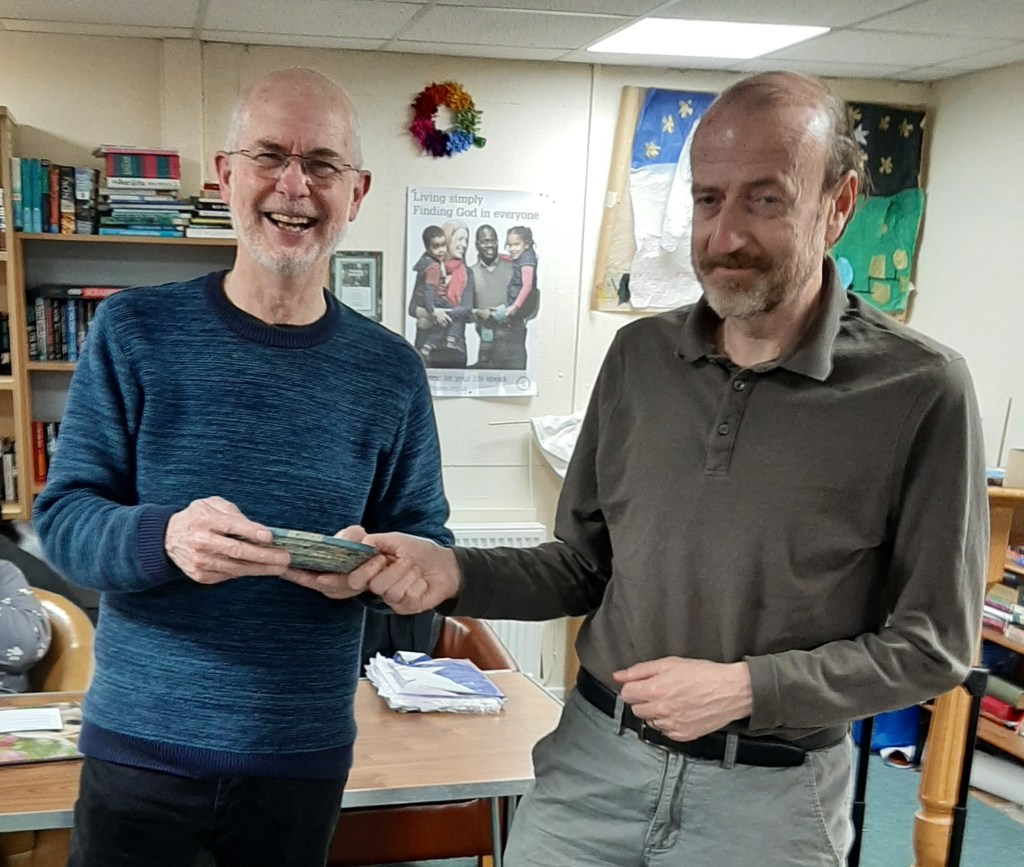
Tuesday saw the adjudication for the Barony Plate to decide the best comedy sketch from all the entries. The winner was John Spowart with his sketch “Bizarre Encounter”, two friends enjoying each other’s company.
Makar Quaich
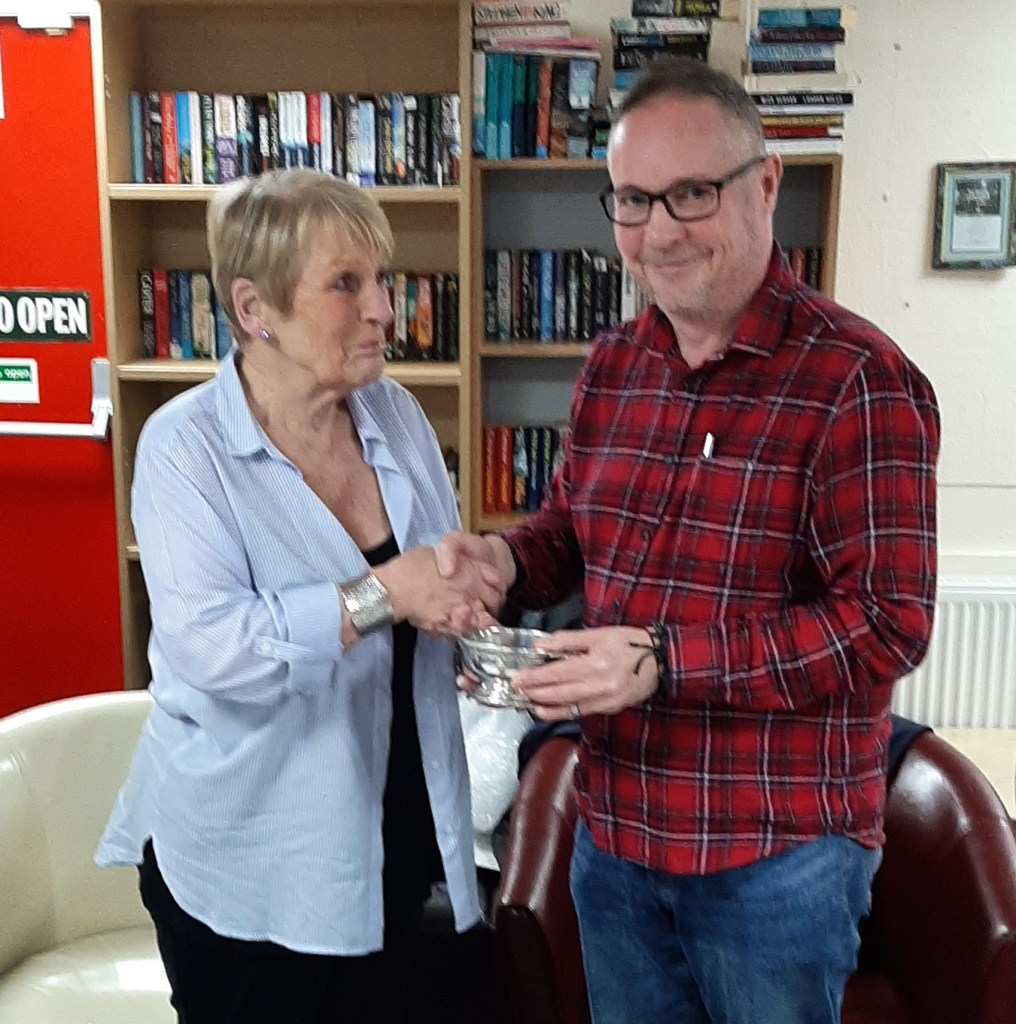
The winner of the Makar Quaich, a short story competition was Dougie Shepherd with his story titled ‘Long Overdue’. This was a tale about a library book borrowed for much longer than intended, perhaps in exceptional circumstances. Here is Dougie receiving his award from the adjudicator, local author Kate Donne.
Here is Dougie’s winning story.
LONG OVERDUE
The alarm clock rang shrilly at 07:15. The usual time for Hans. After a quick wash and shave, Hans prepared himself a light breakfast which consisted of two crispy rashers of bacon and a poached egg – runny, of course – just as he liked it. It was the same routine every day.
Hans took care to dress himself. Smart trousers and an open-necked blue checked shirt. He had polished his shoes the evening before in readiness.
Once dressed, Hans tidied away the breakfast dishes. He attached great importance to things being in their rightful place at all times. Orderliness mattered. Which was why today was so significant for him.
Hans retrieved his heavy, grey woollen overcoat from its’ brass coat hook on the antique coat stand in the hallway, slid his arms inside before carefully buttoning the coat up. He slipped on a striped woollen scarf, taking care to place it neatly within his coat, turned up his lapels and donned his Tyrolean hat. He checked himself in the large oak framed mirror in the hallway to make certain that his hat sat properly straight on his head. He thought to himself that he still looked reasonably good for his advanced years.
He lifted the package, that he had laid out the evening before, from the old writing bureau in the hallway. Hans placed the bundle into a brown leather satchel that he’d had for more years than he could care to remember and placed the strap across his shoulder. He was now ready to go.
He locked the door to his humble but cosy apartment, then made his way down the stairs of the apartment block, making sure not to trip on the array of bicycles that were secured tightly with chains and padlocks to the safety rails in the tiled stairwell.
On exiting the apartment block Hans turned right and through the hole in the wall, careful not to lose his balance crossing the rubble. This took him into Potsdamer Platz. Hans felt the bitter chill and shivered. Little beads of moisture were forming little clouds suspended in front of his face as he breathed the early morning. Winter was beginning to tighten its clutches on the city and Hans was grateful that he had taken the effort to wrap up appropriately for the dwindling temperature.
Although it was still relatively early, Hans observed several workers were rushing hurriedly in different directions, presumably towards their places of employment.
Hans shuffled nervously across the debris littered square, clutching the satchel close to his hip.
He passed a butcher’s shop which was preparing to open for the day’s custom. In the window the owner, who was wearing a pristine white apron, was arranging a neat display of traditional sausages and appetising cuts of meat. Hans tipped his hat, and the butcher returned the gesture with a hearty smile and a wave of his hand.
Hans purchased a Berlin Heute newspaper from a nearby news kiosk, having handed over the correct number of coins to the newspaper seller. Hans looked at the front-page headline: ‘UNITY! Finally, It’s Over!’ in thick typeset beside the date Friday 10 November 1989, before carefully folding the newspaper and placing it into a deep pocket on the inside of his overcoat.
Hans glanced up at the tall, imposing granite structure facing him on the opposite side of the road before shuffling slowly, but safely, across the traffic-less street. He reminisced of the days when this very street was once a major thoroughfare. But no more. Perhaps, he thought optimistically, that it might return at some point soon to its former glory.
On reaching his destination, Hans drew in a sharp intake of breath. He chastised himself for his nervousness, thinking to himself that he was behaving like a silly old man.
On the stroke of 9 o’clock, a security guard removed a large set of keys hanging from his trouser belt before unlocking the revolving front door of the public building. He muttered a polite “Good morning” to Hans before quickly turning around and moving quickly up the stairs towards his office on the top floor of the building.
Hans patted his satchel and slowly followed the security guard up the staircase, taking time to familiarize himself with the surroundings. It had been some considerable time since he had been in the building, and he was surprised at how little the place had changed since his last visit.
On reaching the second floor, Hans slowly approached the public counter with some trepidation, unsure what sort of reception he might receive there.
As he reached the counter a library assistant looked up from her work and observed him with the sort of unwelcoming look someone at passport control counter in a foreign airport might give. Hans awkwardly bent down, carefully undid the straps of his satchel, reached into it and retrieved the package that he’d lifted earlier that morning.
“Good morning, sir,” the assistant addressed Hans. “It’s been quite some time since I last saw you in here. So how can I help you on this rather cold, but delightful, winter’s morning?”
Perhaps she’s simply just being professional, thought Hans to himself, but he strongly felt that he could detect a notable hint of sarcasm in her voice.
“I’m here to return my library book,” replied Hans quietly. “But it’s somewhat overdue,” he added. “But there have clearly been extenuating circumstances.” With that, he opened the package and placed the book gingerly on the counter, sliding it slowly across to the stern looking assistant.
She opened the book’s cover and looking over her spectacles, she said to Hans gravely. “You do realise, Herr Huber, that this book is significantly overdue. Our library service has a strict policy in place concerning the return of overdue books – and that is to apply a financial penalty in such cases.”
Hans shuffled awkwardly in front of the counter and softly responded, “yes, I am aware. But I thought under the circumstances …” and his words seemed suspended in the air.
The library assistant interrupted Hans. “Sir, you realise of course that this book is date stamped as being borrowed by you on the eleventh of August 1961. You have had this book for some twenty-eight years. I do hope that you have a good excuse?”
“Well yes, yes I think that I do actually,” Hans muttered apologetically in response.
“I’d need to calculate this more accurately but at a rate of one Deutsche Mark a week for each week the book was overdue, I reckon that you must owe us something in the region of fifteen-hundred Deutsche Marks!”
She removed her glasses from her face and started sucking on the end of one of the spectacles legs and looked at him with an intensely serious look on her face. She said, “well, what do you say in response to that then, Herr Huber?”
Hans leaned gently on the counter, met the assistant’s gaze and calmly, but with a hint of anxiousness in his voice responded, “look, I’m very, very sorry about this.” Hans paused before delivering the words that he’d carefully prepared in his head for this very moment. “You’ll see if you check back at my record, that until this particular occasion, I have always returned my library books promptly. I have, fortunately, never fallen foul before of your policy and had occasion to incur a charge for the late return of a borrowed book from your library service. Whilst I respect your policy on overdue books and whilst I am, of course, content to pay the fine, I was rather hoping that you might be able to show me some leniency in this instance due to the unprecedented circumstances that surround the late return of this particular book. But it goes without saying that I would most certainly have returned it sooner if it wasn’t for that damned Berlin Wall being built several days after I borrowed the book which has prevented its return for all of this time.”
Their eyes briefly met before they both jointly and unashamedly erupted into gales of uncontrolled and heartfelt laughter.
When the laughter finally subsided, the assistant wiped the tears from her eyes and said, “I think I can let you off on this occasion, Herr Huber.” She then proceeded to date stamp the inside of the copy of ‘War and Peace” before throwing it casually into the basket of books to be returned to their rightful place on the library shelves, smirking inwardly at the unintended irony of the situation.
Confident that the situation had been satisfactorily resolved, Hans asked “I don’t suppose that you have a copy of A Tale of Two Cities that I could borrow perchance . . . “?
“Herr Huber, goodbye.” The assistant waved to Hans, stifling a chuckle to herself as she watched him turn on his heel towards the exit.
Allan Brownlie Quaich
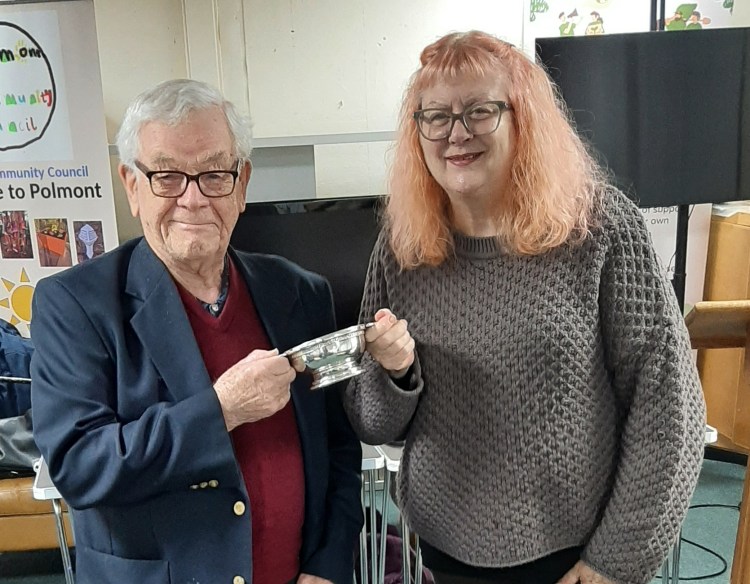
A poetry competition on any topic, the winning entry ‘The Pride O’ Luden Mains’ by Archie Smith (On the left) seen here being presented with the Allan Brownlie Quaich from adjudicator Jim Carruth.
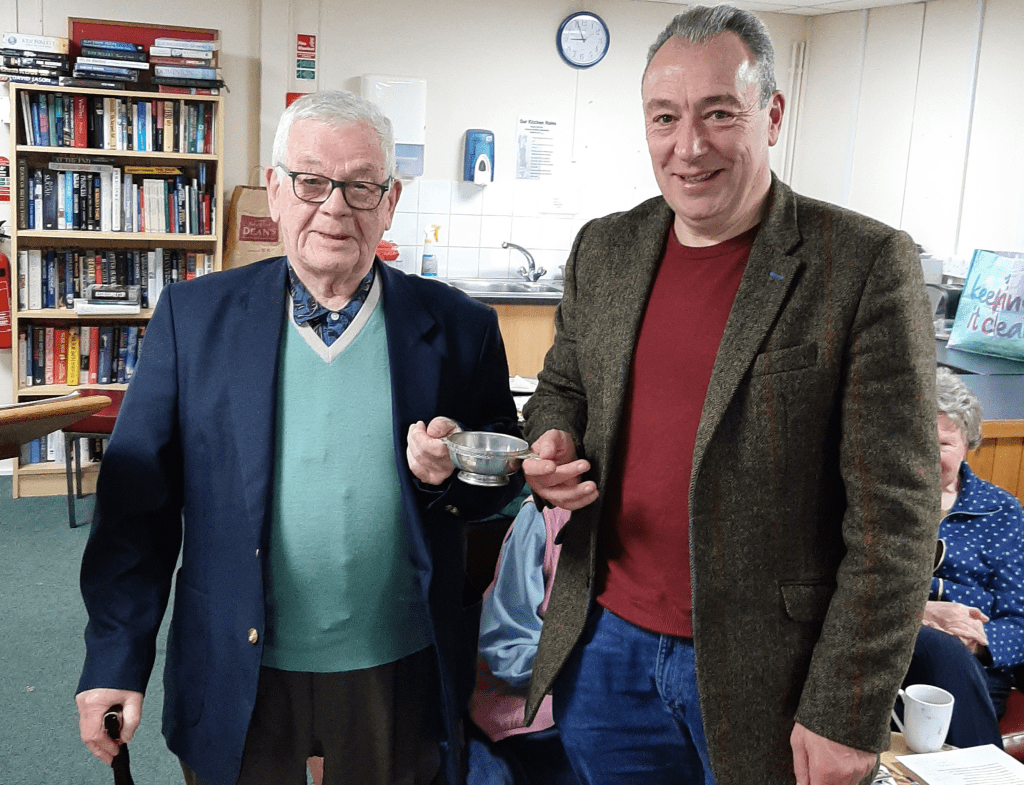
Here is Archie’s winning poem:
THE PRIDE O’ LUDEN MAINS
Kennedy Smith
If ye gang doon by Luden’s Lane
Richt roon ahint Auld Jockie’s hame,
Just tak the pad ye wid ha’ taen
Doun by the brae
An keep on gaun through glaur ‘n rain
Till Bottom Way.
For there you’ll find, if ye tak tent,
A smaw-bit mere the rains hae sent,
A wee bit dub o’ watter meant
Fur slocken kye,
Graced by a stane an‘ dark as Lent
Placed there forbye.
And on this altar, aw in glory
There wis a yin, so goes the story
(And wha am I tae dout Red Rory?)
A mass o’ green;
A muckle puddock sat in glory,
Aw serene.
An’ aw aboot a motley crew
T’were Jessie, Maggs and – you know who!
Plying their wares, some lassies do –
Richt friendly lassies;
Nae dout a day they’ll come tae rue
Ere this month passes.
The Laird -The Puddock – croaks and reigns
An’ roond aboot, his harem dames
The mothers o’ his tadpole bairns
Wee shilpit froggies,
Ken’t as The Pride o’ Luden Mains
And feart by boggies.
 Falkirk Writers Circle